

Ramon Eijkemans
Eikhart - Mad Scientist
Published: October 15, 2026
~  14 min.
Should I translate our website to English for ChatGPT?
No. Not across the board, and almost never as a full copy of your site. There is one narrow case where it helps, and I will get to it, but it is not the default and it is not free.
You have probably heard the pitch by now. Models think in English, so give them English. The first half is true. The second half is where people quietly burn their budget.
Two things go wrong. One is about how the models actually work. The other is the part nobody puts on a slide, which is maintenance.
How the models actually work #
The research behind the pitch (here and here) is solid. Multilingual models make their main decisions in a space that sits closest to English, no matter which language you write in or read back. Work from Oxford and Google DeepMind (Schut, Gal and Farquhar, 2025) shows the model forming an English-shaped version of the meaning-carrying words first, then rendering the answer in your language. An earlier study (Wendler and colleagues, 2024) called English the model's internal pivot.
Picture a game of Telephone. You start with a Dutch word like "ondernemer", which means entrepreneur. On its way through the model the meaning drifts toward its English lookalike "undertaker", and when it comes back out in Dutch you can end up with "begrafenisondernemer". Your entrepreneur is now running a funeral home, because the meaning got settled in English somewhere in the middle. That is real, and it is why the pitch sounds reasonable. If the thing reasons in English anyway, why not hand it English and skip the detour?
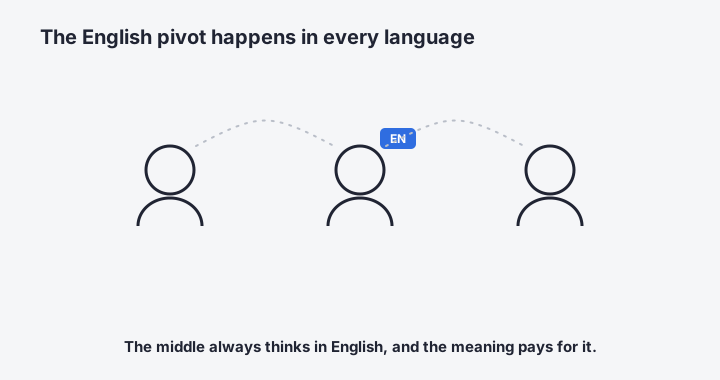
Lost in Translation
Because handing it English does not drop your words into that tidy English core. It drops another page onto the open web, which the model then weighs against everything else that has ever been written about you. Duane Forrester has a good phrase for this. A translated page shows up as a "foreign object", still carrying the fingerprints of the language it came from. It does not inherit your authority. It starts at zero. Every SEO already knows that feeling, because it is what happens when you launch a subdomain next to your main site. Same brand, same universe, and it still has to earn its rankings on its own.
The part nobody budgets for #

The "just translate it" crowd skips the boring bit. A translation is not a job you finish. It is a second website, and now you have to keep it alive.
The bigger your site, the uglier that gets. Ten pages, no problem. Tens of thousands of product and category pages, and you have just agreed to run everything twice. Every price change, every spec, every bit of repositioning now happens in two places, or it happens in one and silently breaks the other.
LLMs also charge you a tax you never paid in classic SEO. You are not allowed to contradict yourself. When a model sees your English page claim one thing and your Dutch page claim another, it does not quietly average the two. It believes you less. A split story is worse than a thin one. So the English version cannot just be good on launch day. It has to stay in step with the original, indefinitely.
Now run it forward, because it plays out the same way almost every time. Your buyers are not English speakers, so the conversions happen on the native pages. The English mirror does not convert. Anything that does not convert slowly loses the internal argument for attention and budget. It starts to age. Prices drift, products change, the positioning moves on and leaves it behind. The page you built to help your AI visibility is now the one contradicting your real pages and pulling you down.
And it gets worse, because these models lean toward English. They may reach for that stale English page first and serve its outdated answer ahead of your current, correct, native one. Pieter Serraris made this exact point: a stale English page is worse than no English page at all.
So translating the whole site is not twice the content. It is twice the upkeep, forever, on the half of the site that brings in the least. The hygiene problems do not show up on day one. They accumulate, and then they compound.
Even the translation vendors say don't translate (but localize) #
This is the part I enjoy most. The companies whose entire business is selling you translation mostly tell you not to lean on it.
Translation agencies say plain translation is not enough and that you have to localize for each market. The GEO tools call translation a starting point rather than a strategy. These are people with every reason to sell you more translation, and even they wave you off the blanket version. When the vendor says their own product will not do the job by itself, it is worth listening.
Localize, do not translate. Sounds like a small correction. It is not. It means writing genuine content for each market and keeping it current, which is more work than translating, not less. Same wall as before. It takes real effort, and then it takes the stamina to keep spending it.
And it is not even always English #
Even when translation is the right call, English is often the wrong target. Which language owns a topic depends on the term, and you can measure that rather than guess.
Myriam Jessier uses a dominance ratio for this. Take the US English search volume for a term, divide it by the local-language volume for the same term, both pulled on the same day from one tool. A high number means the concept lives in English. A low one means the local language owns it. Her skincare examples make it obvious. "Glass skin" in France runs roughly 27 to 1 toward English, so you work in English. "Skin barrier" tips the other way, into French. And "clean beauty" in Germany is not a translation problem at all, because the German market has its own certified category, Naturkosmetik, with its own rules and institutions behind it. Translate "clean beauty" into German and you miss the word your buyers actually type.
The unit that matters is the term, not the country. Which, once again, means patient per-market work rather than a switch you flip once.

What to do instead (it's actually pretty simple) #
Get your consistency right before you even think about a second language. Your pages, your profiles and whatever other people write about you need to tell one story. That already matters in a single language. Translation does not create the consistency problem, it just doubles one you probably already have. If you cannot keep one language clean, do not take on a second.
Full disclosure: this is the work I do, under the name trueroot, so read the emphasis with that in mind. It does not make it less true.
Then test instead of guessing, and the test is almost embarrassingly simple. Take one of your statements, drop it into a translator, DeepL, Google Translate or just ChatGPT, push it to English and back into your own language, and read what comes out. If it still says what you meant, the model can work with that idea. If it drifts, you have found the sentence to fix. Remember the ondernemer from earlier. Send it on that round trip and watch whether your entrepreneur survives or comes back running a funeral home.
One caveat, so you do not over-read it. This checks whether the model understands you, not whether it will pick you. It is a comprehension test, run line by line, not a visibility score.
Visibility is a separate job, and it runs mostly on what other people write about you rather than on your own pages. Find out which sources the model actually cites for you, and in which language, and go build there. Do not assume that language is English. Go and check.
And write for people before you write for the machine. The point was never to get mentioned. The point is that someone gets your message and it helps them. In AI search they often get it without ever clicking, summarized by the model, which only raises the stakes on whether what the model is carrying is right.
So when is English actually worth it? #
When a few things line up at once. You have measured a real problem, and the model genuinely misreads or ignores you in the language that pays your bills. You can fix only the part that is broken instead of cloning the whole site. And the payback arrives before it expires, because the models keep getting better at other languages, so any translation project you start today has a short shelf life.
If that is your situation, add English deliberately, for the exact terms and pages that failed the test, and commit to keeping them current. If it is not, put the money into consistency and local coverage instead, where it works for you over time rather than against you.
So, back to the question #
The model thinking in English does not mean you should. A full English copy is not a one-time translation job. It is a second site you maintain forever, and it is the part that converts least, which makes it the part that rots first. Keep one story straight, test whether the model actually understands you, build where it actually looks, and translate only once you can show it pays off.
Ramon Eijkemans
Eikhart - Mad Scientist
Published: October 15, 2026
~ 14 min.