
- Where we left off
- Pages are not read; they are hunted: about foraging and information scent.
- Language machines are selective readers too
- What the reader is hunting for depends on their moment
- My working hypothesis: capture the moment
- Two sentence types that belong together, with two distinct jobs
- When to use which
- Some easy examples
- More complex examples. Remixing-style.
- What this adds to utility-writing
- What I feel SEOs, especially the technically-inclined, need to understand
- What I'm still figuring out
- References
 26 min.

Ramon Eijkemans
Eikhart - Mad Scientist
Situation and closer: how utility writing serves both humans and machines
Two sentences. Two jobs. Thanks to AI, one of them has become non-negotiable.
For decades, weak content worked. Links, domain authority, and keyword-optimized articles elsewhere on the site carried the weight. The writing itself barely mattered as long as the technical signals were right. Sure, we did some meta text writing, some headings, some small pockets of keyword-stuffed texts here and there, where there some pixels left in the design.
But let's be honest, it wasn't exactly something to be proud of.
That is changing quite hard these days. Language machines do not follow links. They read text. And a page full of context-dependent, loosely-structured copy gives them nothing to extract.
And sure, they use indices like Common Crawl to decide what to crawl and what not (tip: read Metehan's research about it). But still, the direction is clear: language machines have removed that escape route, whether you accept it or not. So we need to up our game. You can no longer rank on authority alone while burying the promise in context-dependent prose. The writing has to carry the weight - or at least: waaaaaay more of it - now.
In fact, I'd argue that this should have been the main mantra in SEO for years already, especially since Google started using passage indexing.
Language machines have removed the escape route that links and domain authority provided for decades. A page built from context-dependent, loosely-structured prose is not less likely to rank in AI retrieval: it is genuinely unextractable. Utility-writing is not a nice-to-have. It is the only kind of writing that survives.
Ramon Eijkemans
See what I did there? With the quote? That's utility-writing in effect.
If you haven't already, now is a good time to read my two preceding articles about language machines, the way they interpret text, what all of them (roughly) have in common, and how to deal with that. A fair warning though: they're long, information-packed, with lots of examples. Take your time, it's worth it, i promise:
Did you read them? Kudos. Let's move on then!
Where we left off #
In my utility-writing article (I'm linking here again, you really should have read it by now), I ended with two things I hadn't figured out yet.
-
1.
How to use a sequence of sentences within a block of copy: when to name a situation, when to anchor it.
-
2.
How that plays out in actual design components (hero sections, situational blocks, FAQs) rather than in abstract principles.

Something changed
I didn't use the exact wording 'situation' and 'closer' yet in the first draft. But i guess we're all learning! I now use 'situation' and 'closer'.
Why that is? Read on.
Working on a content briefing for a client gave me a concrete answer to both questions I was still left with. Not as a theory, but as something I actually had to write and make decisions about sentence by sentence. What emerged from that process is what this article is about.
Pages are not read; they are hunted: about foraging and information scent. #
When someone arrives at a page, they don't start at the top and read to the bottom. They scan. They're looking for a signal that tells them this page holds what they came for. If that signal appears, they stop and read. If it doesn't appear fast enough, they leave.
This isn't a modern attention-span problem. It's how information seeking has always worked.
Peter Pirolli and Stuart Card formalized it in 1999 under the name information foraging theory1. The analogy they drew was deliberate: humans seeking information behave like animals foraging for food. They move through an environment, picking up signals that indicate whether a given patch is worth pursuing. When the signal is strong enough, they stay and feed. When it weakens below a threshold, they move on.
The key concept is information scent: the signal a piece of content emits that tells the forager how likely it is to satisfy their current need2. The scent is not the content itself. It's the cue that the content is there. A heading that names the situation. A first sentence that describes the problem. A phrase that the reader recognizes as their own.
Nielsen Norman Group's eye tracking research confirms what this looks like in practice3. Across studies with over 500 participants and more than 750 hours of observation, the finding is consistent: people don't read web pages, they scan them. The specific pattern varies with page structure and reader intent; but what stays constant across all patterns is that most of the page is never fixated. What gets read is what the scanner found strong enough to stop at.
The practical consequence for anyone writing web content: if your most important sentence sits in the middle of a page, behind three paragraphs of context, most readers never reach it. Not because the content is bad. Because the scent wasn't strong enough to pull them that far.
So the concept is this basically:
Information scent is not the content itself. It is the signal a piece of content emits that tells the reader whether this page is worth stopping at. A heading that names a familiar situation. A first sentence that describes a problem the reader already has. A phrase that feels like it was written for them specifically.
Ramon Eijkemans
Language machines are selective readers too #
Language machines (LLMs, search engines, AI assistants, and agents built on transformer architectures: systems that retrieve and rank text by scoring chunks against learned semantic representations) do not read a page from top to bottom either. They select. The retrieval process works by scoring chunks of text against the query and extracting the highest-relevance passages. Petrovic's analysis of Google's Gemini grounding system found a total budget of approximately 2,000 words per query, distributed across sources by relevance rank4. Of a 6,000-word page, only a fraction gets selected. The rest is invisible.
The mechanism is different from human scanning though. A human scanner follows visual and semantic cues: headings, bold text, first sentences, whitespace. A language machine scores text chunks against a query using semantic similarity. It doesn't see visual hierarchy.
But the practical consequence for the writer is the same: a sentence that doesn't carry its own context is invisible to both readers. The human scanner doesn't pick up the scent. The language machine can't extract the chunk as a standalone, usable proposition.
This is the connection utility writing was building toward but hadn't fully named. The five lenses (position your best material, give the system a reason to pick you over alternatives, make every sentence survive on its own, state relationships explicitly, include a sentence a language machine could directly quote) are all, at their core, scent-building techniques. They make sentences strong enough to be found by either type of reader.
What this article adds is a sequencing layer: not just which sentences need to carry their own scent, but in what order the different types of sentence need to appear, depending on what the reader is hunting for.
What the reader is hunting for depends on their moment #
Not all readers arrive at a page hunting for the same thing. And that changes which sentence is the one to start with.
Eugene Schwartz described this in 19665. His five stages of customer awareness (from unaware through problem-aware, solution-aware, and product-aware, to most aware) are a map of how much of a defined question the reader has already formulated before they arrive.
His core observation: "In its natural development, every market's awareness passes through several stages. The more aware your market is, the easier the selling job, the less you need to say."6
The logic: a reader who hasn't formulated a problem yet can't evaluate a solution. Before they can assess information, they first need to recognize that the information is relevant to them. The sentence that creates that recognition doesn't do less work than the sentence that delivers the specification. It does different work, and it has to come first.
Schwartz described this at the level of campaigns and headlines. What this article adds is the sentence level: which type of sentence needs to open a given block of copy, depending on what question the reader has already formulated7.

This is a sequential model, I know. But it's still useful
Schwartz's awareness stages are sequential by design. Real journeys aren't. We know this by now.
Someone can land on a pricing page having never heard of you, or leave a product page to compare on a competitor's site and never come back. That's fine. This framework doesn't map a journey; it reads a moment. What happens before or after that moment is someone else's page, someone else's platform, or nobody's business at all.
There is data that supports the underlying principle at scale. Unbounce's 2024 analysis of 57 million conversions across 41,000 landing pages found that email traffic converts at a median of 19.3%, while display advertising traffic converts significantly below that8. The pages are often identical. What differs is the reader's awareness stage on arrival. Email readers already know the brand and have a partially formulated question. Display readers are still hunting for the scent. Same page, same copy, conversion rates that differ by a factor of four or five9.
My working hypothesis: capture the moment #
Pirolli and Card showed that what counts as a strong enough signal depends entirely on what the forager is looking for. Schwartz showed that what a reader is looking for depends on how much of a question they have already formulated. Kahneman showed that without a defined question, System 2 doesn't activate and specification-dense content passes unprocessed.
The practical consequence of combining these: the sentence that needs to open a block of copy is not fixed. It depends on the reader's state on arrival. A reader without a question needs a situation sentence first. A reader with a fully formed question needs the answer first.
This is my synthesis of the three, and it seems to be useful10.
I use four distinct reader states, each defined by how much of a question the reader has already formulated on arrival:
| Moment | Explanation |
|---|---|
| Browsing | No defined question yet |
| Recognizing | A problem is felt - somewhere - but not yet fully articulated. |
| Comparing | A question is fully formed and the reader is evaluating options. |
| Confirming | A decision has been made and the reader needs the last piece of information to act. |
Each state calls for a different sentence to open. That is what the rest of this article maps out11.
Two sentence types that belong together, with two distinct jobs #
Working through the briefing, I found myself making the same decision repeatedly at the sentence level. Every block of copy had two layers. One layer did recognition work. One layer did anchor work. And the order between them depended on what question the reader had already formulated.
I've been calling them situation sentences and closers:
-
1.
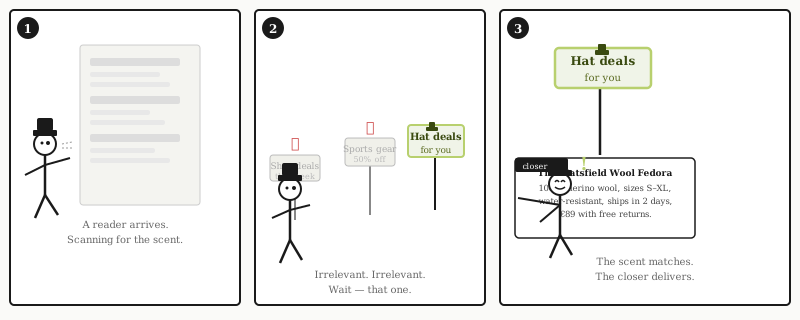
A situation sentence describes a moment, a tension, or a context the reader recognizes as their own. It emits the scent. It makes the reader stop scanning. It doesn't name the product, the price, or the specification. It names the situation.
-
2.
A closer is what the reader finds when they stop. It's the fully self-contained, extractable claim: named entities, conditions stated inline, timeframe included, no unresolved references. It works for the reader who just stopped scanning. It works for the language machine scoring chunks against a query. Both need the same thing from this sentence, which is that it stands completely on its own.
Both can carry emotional weight. Both can carry factual content. What distinguishes them is function: the situation sentence emits a signal, the closer is what's found when the signal is followed.
The two are not equal in weight. The closer is the foundation: it is the unit that survives extraction, serves the comparing reader, and gives the language machine what it needs. But it only reaches the browsing or recognizing reader if a situation sentence has first made it worth their while to stop12. Write the closer first. Then decide how much situation the reader needs to get there.
The distinction maps onto two different writing traditions. Situation sentences are the domain of advertising writers (the kind of sentence Schwartz, Ogilvy, and Bernbach spent careers perfecting). They are psychological before they are informational: they work because they name something the reader already feels. A promise, in other words.
Closers are where that promise is kept. They are the domain of utility writing: no atmosphere required, just a claim that stands completely on its own. And as language machines take over more of the conversation (selecting, extracting, and summarising on behalf of the reader) the closer becomes the unit that survives. The situation sentence draws the reader in. The closer is what gets found.
How to recognise a situation sentence. Explanation + examples #
A situation sentence names a moment the reader is already in. Not a product. Not a benefit. A moment.
The fastest test: can the reader say "that's me" when they read it? If yes, it's a situation sentence. If it requires knowing something about the product first, it isn't.
One practical observation: the most effective situation sentences tend to be loss-framed rather than gain-framed. A gain-framed sentence promises something better: "imagine running without effort." A loss-framed sentence names something already wrong or unresolved: "most shoes are built for tracks." The difference matters because loss-framing activates faster. The reader isn't being offered a future state; they're being recognized in their current one. Prospect theory predicts this: losses register more immediately than equivalent gains13.
That said, here are some examples across different industries and page types. All loss-framed:
-
-
E-commerce, running shoes: Most running shoes are built for tracks. Your runs are on pavement.
-
-
B2B SaaS, project management: Three teams, two tools, one conversation nobody is having.
-
-
Real estate, apartments: You've looked at twelve places and none of them felt like yours.
-
-
Healthcare, back pain: It's not that it's unbearable. It's that it's always there.
-
-
Legal, employment dismissal: You didn't see it coming, and now you don't know what you're entitled to.
-
-
Travel, family holidays: Everyone has an opinion about where to go. Nobody agrees.
-
-
Finance, business loans: The invoice is paid. The supplier isn't.
-
-
Fashion, workwear: You've been dressing for the job you had. The meeting changed that.
-
-
Software, accounting: You know the numbers are out there, somewhere. Finding them is the problem.
-
-
HR tech, onboarding: New hire starts Monday. The account isn't set up yet.
How to recognise a closer. Explanation + examples #
A closer contains everything needed to understand the claim without reading anything else on the page. It can be extracted by a machine and understood by a reader arriving cold.
The fastest test: if you paste this sentence into a blank document with no context, does it still make sense? If yes, it's a closer. If it relies on what came before, it isn't.
Examples:
-
-
E-commerce, running shoes: The Nike Pegasus 41 is a daily training shoe with a React foam midsole, available in men's and women's sizing from UK 3.5 to UK 13, at £124.95.
-
-
B2B SaaS, project management: Asana's Business plan at $24.99 per user per month includes unlimited projects, custom fields, workflow automation, and portfolio reporting for teams of any size.
-
-
Real estate, apartments: The two-bedroom apartment at Plantage Middenlaan 14 is 78m², available from 1 March, and rents at €2,150 per month excluding service costs.
-
-
Healthcare, back pain clinic: The initial consultation includes a physical assessment, a movement screen, and a written treatment plan, and takes 60 minutes at our Amsterdam or Haarlem locations.
-
-
Legal, employment dismissal: Employees dismissed without a valid reason or proper procedure are entitled to a transition payment under Dutch employment law, regardless of contract type, provided they have been employed for at least one month.
-
-
Travel, family holidays: The Ikos Aria in Kos, Greece is an all-inclusive resort with a dedicated children's club for ages 4–12, sea-view family suites from €480 per night in July, and free cancellation up to 30 days before arrival.
-
-
Finance, business loans: Approved applications receive a credit decision within four hours and disbursement within 24 hours, for amounts between €10,000 and €500,000, with a fixed monthly fee and no early repayment penalty.
-
-
Fashion, workwear: The Arket Double-Faced Blazer is cut from a wool-cotton blend, available in navy and stone, in sizes 32 to 46, at €299.
-
-
Software, accounting: Exact Online's Essential plan at €39 per month includes VAT returns, bank reconciliation, invoicing, and a direct connection to your Dutch business bank account.
-
-
HR tech, onboarding: Rippling creates accounts in 90+ business applications automatically on the employee's start date, based on their role, department, and location, without manual IT tickets.
What these have in common: named entities, specific numbers, conditions stated inline, no pronouns without antecedents, no vague qualifiers. A human reader arriving cold can evaluate it. A language machine can extract it as a standalone answer.
No "we", "our", "it", "this", "here". Every reference is resolved. Every condition is explicit.
When to use which #
The question isn't which type of sentence is better. It's which type the reader needs first, given what they already know when they land on this page.
The main question: does this reader arrive with a specific problem to solve?
What could possibly go wrong if you don't listen to me ;) #
Getting the order wrong is not a subtle problem. The reader either leaves or stalls, and neither shows up in your copy review.
-
-
A closer without a situation sentence on a browsing page: accurate but cold. Robot-style. The reader has no reason to stop scanning.
-
-
A situation sentence without a closer: the reader recognizes themselves but has nothing to hold onto. The scent activated something; then it dissolved. Unfulfilled promise.
-
-
A situation sentence on a comparing page: the reader came for criteria and got a mood. Wrong mood. They leave.
-
-
A second sentence on a confirming page: you're re-arguing a decision the reader already made. Basically insulting them.
So, here is a table that summarizes it:
| Moment | What the reader is hunting for | Opens with | Closes with |
|---|---|---|---|
| Browsing | Recognition that this page is relevant | Situation sentence | Closer |
| Recognizing | Confirmation of their exact situation | Situation sentence | Closer |
| Comparing | Answer to their comparison question | Closer | Situation sentence (optional) |
| Confirming | Verification of their conclusion | Closer | Nothing |
Each moment calls for a different pattern on the page. The examples below show what that looks like in practice.
Some easy examples #
The four-moment model maps onto pages. The same product category, in any given industry, can have pages that serve completely different moments.
For example, a law firm's general practice page catches browsers. Its dismissal page catches recognizers. Its fee structure page catches comparers. Its intake form page catches confirmers. Each needs a different sentence to open.
Below are some more examples.
A fashion product page (browsing and recognizing) #
The reader landed on a specific product but hasn't yet answered "is this for me?" The situation sentence makes the experience of the product visible. Once that recognition has landed, the closer earns its place.
Situation sentence:
The kind of dress you reach for when you want to feel unhurried.
Closer:
The Arket linen midi dress in natural white is cut from 100% European linen, available in sizes XS to XL, at €129.
Without the situation sentence, the closer is accurate but cold. Without the closer, the situation sentence resonates but anchors nothing. The pair works because one earns the right for the other to land.
A B2B SaaS pricing page (comparing) #
The reader knows what the product does and is deciding whether to commit. They came for criteria. The closer opens:
The Pro plan at $23 per host per month includes APM with distributed tracing, 15-month metric retention, and up to 200 custom metrics per host.
Optional situation sentence close:
No surprises at invoice time.
The closer does the work. The four-word situation sentence removes the last friction without reopening the case. Whether to include it depends on how much anxiety sits underneath the decision. Higher stakes, more useful.
A travel booking summary page (confirming) #
The reader has decided. More copy actively hurts. One closer:
The Riad Fes in Fez, Morocco is located 200 metres from the Bab Boujloud gate in the medina, with a rooftop restaurant, rooms from €180 per night in low season and €340 in peak season (April to May and September to October), and free cancellation up to 48 hours before arrival.
Everything in one sentence. Adding anything after it is noise14.
More complex examples. Remixing-style. #
The examples above each show a single situation sentence paired with a single closer. But the model also works at page level, across multiple closers. A listing page (a category page, a comparison overview, a legal rights summary) can open with a situation sentence that names the reader's context, follow with a closer that describes the category as a whole, and then use utility headings to group the product closers beneath.
The situation sentence earns attention. The category closer gives the language machine a single extractable claim about what this page covers. The utility headings act as taxonomy markers. And each product closer stands on its own: findable, scorable, and usable without the context above it.
Synergy FTW
This actually, literally saves you words. It makes the utility more efficient, and provides taxonomy-style context for language models at the same time.
Useful when negotiating with UX about available pixels on the screen ;)
Three examples across different industries:
E-commerce, running shoes #
Situation sentence:
You run on pavement. Most shoes are built for tracks.
Category closer:
Road running shoes are engineered for impact absorption on hard surfaces, rated by weekly mileage load and foot strike pattern, and fitted to runners who prioritize joint protection over speed.
With below it lists with category listings, starting with "daily trainers":
- The Nike Pegasus 41 is a daily trainer with a React foam midsole, rated for road surfaces up to 70km per week, available in men's and women's sizing from UK 3.5 to UK 13, at £124.95.
- The Brooks Ghost 16 is a neutral cushioned shoe for heel strikers, rated for road and light trail up to 60km per week, available from UK 3 to UK 15, at £134.95.
And then "Stability shoes":
- The ASICS Gel-Kayano 31 is a stability shoe with structured arch support, suited for overpronators running 40 to 80km per week on mixed surfaces, at £159.99.
Don't shoot the messenger
Of course it is not absolutely necessary to provide the full product texts on a listing page: that's what the product pages themselves are best suited for. This is an example. YMMV.
B2B SaaS, project management #
Situation sentence
Your team is growing. Your current setup isn't.
Category closer
Project management tools for growing software teams differ primarily on planning model, integration depth with developer tooling, and whether pricing scales per seat or per workspace.
Category, per-seat pricing:
- Asana's Business plan at $24.99 per user per month supports unlimited projects, custom fields, and workflow automation for teams of any size, with native integrations for Salesforce, Jira, and Slack.
- Linear is a project management tool built for software teams, with cycle-based planning, GitHub integration, and a flat rate of $8 per user per month on the Standard plan.
Another category, workspace pricing:
Notion's Team plan at $10 per user per month combines docs, wikis, and project boards in a single workspace, with an API for custom integrations and a 90-day version history.
Legal, employment dismissal #
Situation sentence:
You've been let go. Now you need to know what you're owed.
Category closer:
Employee rights on dismissal under Dutch employment law depend on contract type, length of service, and whether the dismissal followed the correct legal procedure.
And then the first category, Financial entitlements:
- Employees dismissed without valid reason are entitled to a transition payment equal to one third of a monthly salary per year of service, with a maximum of €94,000 gross or one annual salary if that is higher.
- Employees who believe their dismissal was unreasonable may submit a claim to the subdistrict court within two months of the dismissal date for fair compensation in addition to the transition payment.
And the second category, procedural entitlements:
- Employees on a permanent contract are entitled to a notice period of one to four months depending on length of service, during which salary and benefits continue.
- Employees dismissed without the correct UWV or subdistrict court procedure in place may request reinstatement or additional compensation within two months of the dismissal date.
What this adds to utility-writing #
The five utility-writing lenses haven't changed:
-
1.
Position your best material where systems find it
-
2.
Give the system a reason to pick you over alternatives
-
3.
Make every sentence survive on its own
-
4.
State the relationships, not just the entities
-
5.
Include at least one sentence a language machine could directly quote
What this article adds is a sequencing layer on top of those five. The lenses describe what makes a sentence useful to a machine. The moment-based pattern describes when each type of sentence does its best work for a human, and how to align the two.
In browsing and recognizing: the situation sentence emits the scent that pulls the reader toward the closer. In comparing: the closer opens because the reader has already found the scent and wants the content. In confirming: the closer is the whole thing.
The closer is not optional. It is mandatory. A self-contained, fully-resolved proposition with named entities, inline conditions, and no unresolved references is the unit a language machine can extract without surrounding context. That is not a stylistic preference. It is a structural requirement for content that survives AI retrieval.
Everything else in this article is about getting the human reader to the closer. The situation sentence activates the schema. The sequencing logic calibrates the order. The four moments tell you how much seduction the reader needs before the utility can land. Some readers need none. A confirming reader and a language machine have identical requirements: one closer, nothing else.
Machines are trained on human behaviour. They have learned to find what humans find useful. If you optimize for the machine first, you strip the humanity from the content and lose the human reader. If you optimize for the human first, the machine follows. It always has.
Write the utility first. Build the seduction around it.
What I feel SEOs, especially the technically-inclined, need to understand #
Utility-writing is a lever to pull. Something that gets you results. I know we've looked at pagerank sculpting, and speed, and log file analysis, and serverside rendering, and all that stuff. But pretty please with cream and sugar on top: realize that this is way more useful than putting some keywords in a title.
If you ask me, it's a new level that we need to unlock in this optimizing game. Don't ignore it!
What I'm still figuring out #
The sentence-order hypothesis is consistent with information foraging theory, Schwartz's awareness stages, and dual-process theory, and with what I've observed in content that performs well. But the research I'm drawing on comes from controlled experiments and navigation studies, not from content optimization at the sentence level. Test this in your own context. Break it deliberately. See what the pattern actually is. I'm know I am.
What counts as the dominant question varies by page type and product category in ways that are probably more complex than the examples here suggest. The framework applies; the calibration is always specific to the page. And the situation sentence / closer labels describe function, not content: the same sentence can do situation work in one context and closer work in another.
A gap I haven't addressed: measurement. The article describes what to write and in what order, but gives no signal for how to know if the sequencing worked. I think, assume that conversion rate is too noisy. Dwell time is too blunt. But to be honest: I haven't scientifically validated all this yet. My goal is application, not science. And I'm too busy getting results anyway :)
References #
- 1 Pirolli, P. & Card, S. "Information Foraging." "Psychological Review", 106(4), 643-675, 1999. Developed at PARC (formerly Xerox PARC) in the early 1990s, published in 1999. The theory applies optimal foraging theory from biology and anthropology to human information seeking. Cited over 18,000 times. Original theory concerned how people navigate between pages and sites; the within-page application is supported by a separate body of eye tracking research (see note 3). back
- 2 Information scent is Pirolli & Card's technical term, not a metaphor: the signal a content source emits that allows a forager to estimate how likely it is to satisfy their current information goal. Scent is goal-dependent: the same page can have strong scent for one reader and zero scent for another with a different goal. back
- 3 Nielsen Norman Group. Eye tracking research spanning three studies over 13 years, over 500 participants, 750+ hours of observation. Key findings published as "F-Shaped Pattern For Reading Web Content" (2006), "F-Shaped Pattern of Reading on the Web: Misunderstood, But Still Relevant" (2017), "Text Scanning Patterns: Eyetracking Evidence" (2019). Dominant finding across all studies: people scan rather than read, and scanning behavior is consistent across sites, tasks, and devices. back
- 4 Petrovic, D. "How big are Google's grounding chunks?" DEJAN, December 2025. Analysis of 7,060 queries and 2,275 pages. The dataset is not publicly shared and the methodology has not been independently replicated, which limits the precision of specific figures. The directional finding (selection is limited, relevance-ranked, and density-sensitive) is consistent with what is known about RAG architectures and is sufficient for the argument made here. back
- 5 Schwartz, E. "Breakthrough Advertising." 1966. The primary text is out of print. Quotes and principles cited via secondary sources including: auresnotes.com (summary, 2023), leadgen-economy.com (Five Stages of Awareness, 2026), b-plannow.com (Schwartz Pyramid guide, 2025), copycraftco.com (States of Prospect Awareness, 2022). These secondary sources are consistent with each other and with the principles as widely cited in the copywriting literature. back
- 6 Schwartz (1966), cited via secondary sources (see note 5). back
- 7 Schwartz described the awareness-stage logic at the level of campaigns and headlines. The situation sentence / closer structure is an application of his principles to individual sentences within a content block; consistent with what he described, but not something he specified himself. When I first approached this problem I framed it as emotional versus factual sentences, and Schwartz seemed to support that framing. It doesn't hold up. The distinction isn't about content type; it's about function. A sentence that names a situation can be entirely factual. A closer can carry genuine emotional weight. For the unaware stage Schwartz writes: "You are selling nothing, promising nothing, satisfying nothing. Instead, you are echoing an emotion"; which maps to what the situation sentence does. For the most aware stage, Schwartz writes that your headline need state little more than the name of your product and a bargain price; which maps to the closer-only pattern of the confirming moment. back
- 8 Unbounce. "2024 Conversion Benchmark Report." Analysis of 57 million conversions across 41,000 landing pages and 464 million unique visitors. Email traffic median conversion rate: 19.3%. Display traffic converts significantly below email; Unbounce explicitly advises against relying on display for direct conversions, but does not publish a single cross-industry mediaan for display in the publicly available report. back
- 9 The awareness-stage interpretation of the email/display gap is plausible and consistent with the data, but not the only explanation. Trust (email recipients already know the brand) and selection bias (subscribers are pre-qualified) also contribute. The gap is real; the cause is likely a combination of factors. back
- 10 This is a working hypothesis derived from pattern recognition across a set of writing decisions, consistent with information foraging theory, Schwartz's awareness stages, and dual-process theory. It hasn't been tested experimentally at the sentence level in a content optimization context. The theoretical reasoning is sound; the empirical validation is missing. back
- 11 The non-linearity of buyer journeys (a common critique of awareness-stage models) doesn't affect this framework. It makes no claim about journey sequence, only about the dominant question a reader has when they land on a specific page. Readers arrive from different directions at different stages; the framework serves whoever arrives. back
- 12 Cognitive load theory (Sweller, 1988) describes the limits of working memory and the role of existing schemas in processing new information. A reader cannot encode new information without a schema to attach it to. The situation sentence functions as schema activation: it brings an existing mental structure to the surface so that the closer can be processed against it. Without schema activation, the closer hits working memory with no anchor. This is the theoretical explanation for why a closer without a preceding situation sentence feels "accurate but cold" on a browsing page. Sweller, J. "Cognitive load during problem solving: Effects on learning." "Cognitive Science", 12(2), 257-285, 1988. back
- 13 Prospect theory (Kahneman and Tversky, 1979) predicts that losses loom larger than gains in human decision-making. Loss-framed situation sentences activate the reader faster because they name an unresolved tension rather than a future benefit. The reader is not being promised something; they are being recognized in a state they already occupy. Tversky, A. & Kahneman, D. "Prospect Theory: An Analysis of Decision under Risk." "Econometrica", 47(2), 263-291, 1979. back
- 14 Dense X Retrieval (Chen et al., EMNLP 2024): proposition-level retrieval outperforms passage and sentence-level retrieval across all tested architectures. A sentence that resolves its own references and preserves conditions inline is the natural language equivalent of a well-formed proposition; extractable without surrounding context by both a confirming human reader and a language machine. back
- Where we left off
- Pages are not read; they are hunted: about foraging and information scent.
- Language machines are selective readers too
- What the reader is hunting for depends on their moment
- My working hypothesis: capture the moment
- Two sentence types that belong together, with two distinct jobs
- When to use which
- Some easy examples
- More complex examples. Remixing-style.
- What this adds to utility-writing
- What I feel SEOs, especially the technically-inclined, need to understand
- What I'm still figuring out
- References
26 min.
Ramon Eijkemans
Eikhart - Mad Scientist